Premium Business Cards: A Buyer's Guide
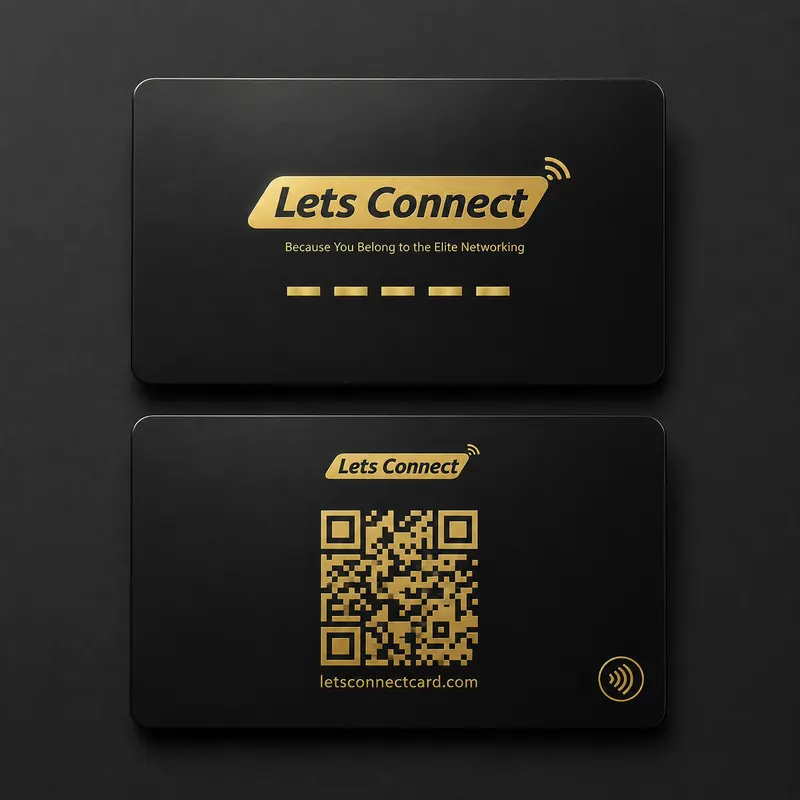
By Business Cards Store Editorial Team | Published | Updated | Buying guides
"Premium" is one of the most used words in printing, and one of the least defined. For a card you hand to someone, it should mean something you can check. This guide breaks it into five parts, compares the three materials sold here, and helps you decide when metal is worth paying for and when PVC is the better buy.
What premium means for a card you hand over
Think about the moment someone takes your card. They notice five things, usually in this order.
- The material. Plastic, wood or metal. This is the first thing a hand registers.
- How it feels. Cool or warm, smooth or grained, rigid or flexible.
- The edge and corners. Clean edges look finished. Look at the edges and corners in the product photos; we don't list an edge treatment as a separate option.
- Colour and print contrast. Can they read your name at arm's length? Does your logo stand out from the card?
- What happens next. When they tap or scan it, does a tidy, up-to-date profile open? Or an old website?
Most cards only get the first four right. The fifth is where a card either earns its price or ends up in a drawer.
Feel in the hand
People often say a premium card has weight. We don't publish weights or thickness for the bamboo and metal cards, so we won't compare them in numbers. Judge by the material instead. Metal is cool to the touch and dark. Bamboo is warm and shows its grain. PVC is smooth, even and familiar, like a bank card.
Colour and contrast
Contrast matters more than colour. A light name on a dark card, or a dark name on a light card, reads at a glance. A dark logo on black PVC or black metal can disappear. If your logo is dark, ask for a light version of it on dark cards, or choose a light-coloured material such as White bamboo.
The profile behind the card
Every card here opens an online profile you edit yourself. That is what keeps a premium card premium. If you change role, number or website, you update the profile and every card you have already handed out shows the new details. You never reprint for a change of detail.
Signs a card is not premium
It helps to know what to avoid. Whatever the material, a card loses its effect when:
- The text is hard to read. Small type, low contrast or a busy background.
- The details are out of date. A crossed-out number or a handwritten correction undoes any material.
- The logo is cramped. Squeezed against an edge, or too small to recognize.
- It opens nothing useful. A QR code that leads to a broken page, or a profile nobody has filled in.
- It tries to say everything. Five phone numbers, three addresses and a slogan leave no room to breathe.
None of these are fixed by spending more. They are fixed by checking the proof and keeping the profile current.
PVC vs bamboo vs metal, as sold here
All three materials are 85.6 × 54 mm, the size of a bank card. All three have an NTAG215 NFC chip and a printed QR code. They open the same kind of profile. The difference is the look, the feel and the price.
| PVC | Bamboo | Metal | |
|---|---|---|---|
| Look | Solid, even colour | Natural grain, no two alike | Dark, with gold or silver detailing |
| Feel | Smooth and familiar | Warm, natural surface | Cool, metallic |
| Colours | Black, Green, Brown, Blue | White bamboo, Original bamboo | Black & Gold, Black & Silver |
| Who it suits | Teams, frequent handouts, trades | Natural and craft brands, hospitality | Client meetings, senior roles |
| UK from | £49 | £99 | £149 |
| US from | $79 | $149 | $209 |
Prices include the Brand Presence profile plan, paid once. Other stores show their own prices on the card page, and stores marked "Price on request" give a quote through the contact page. For a closer look at each material, read PVC vs bamboo vs metal compared.
When metal is worth it
Metal is the most formal card in the store, and the highest priced. It is worth it when:
- You hand over one card at a time. In a client meeting, a pitch or an interview, the card is noticed. At a busy stand, it is one of many.
- Your role is senior or client-facing (see executive business cards). Partners, directors, advisers and consultants often choose metal for this reason.
- Your brand works in black. Both metal colourways are black, with gold or silver. A logo with a light or metallic version suits them well.
- You don't need many. If you give out a handful of cards a month, the extra cost per card matters less.
Our guide to metal business cards compares Black & Gold with Black & Silver and lists what to check before ordering. For layout and restraint, read luxury business cards.
When PVC is the right buy
PVC is the lowest-priced material, and for many buyers it is simply the better choice.
- You hand out cards by the dozen. Events, trade shows, markets and sales calls.
- You are buying for a team. Four colours let you match branding, and every card opens its owner's own profile.
- Your logo is colourful or detailed. A solid, even surface gives the most predictable print.
- You want to start simple. Every feature that matters, the chip, the QR code and the profile, is the same as on metal.
Choosing PVC doesn't mean choosing a lesser card. It means putting the money where it changes the result.
Where bamboo fits
Bamboo sits between the two. It suits cafés, florists, studios, makers and anyone whose brand leans natural. It also suits people who want something more distinctive than plastic without the formality of metal. White bamboo is pale and works well with dark logos. Original bamboo is the natural colour and suits warm palettes.
Whichever you choose, the card should match your brand colours. Lay your logo next to the card photos on the product page before you decide.
The add-ons that change the impression
Three add-ons change what is printed. Each is priced on the card page.
- Add Logo prints your logo. In the UK it costs £20.
- Fully Custom Design lets you upload your own front and back artwork, £30 in the UK. Choose this if you have a full design or need something the standard layout doesn't offer.
- Remove LC branding takes the platform partner's mark off the card, £20 in the UK.
You choose Add Logo or Fully Custom Design, not both. Removing the partner branding is the add-on most often chosen with metal, because it leaves only your own name and mark on the card.
Premium for a team
A team order is where a premium choice either looks consistent or falls apart. A few rules keep it tidy.
- Pick one layout. Use the same logo, or the same Fully Custom Design artwork, on every card.
- Choose materials by role, not by person. For example, metal for partners and PVC for everyone else.
- Keep titles short and consistent. "Director" on one card and "Managing Director, Operations" on another looks uneven.
- Fill in every profile. The profile is what people see after the meeting. An empty one undoes a good card.
Each card in the basket gets its own name and its own profile, so a team needs one card per person. For a large team, contact us before you order.
A simple way to decide
| Your situation | Material | Add-on to consider |
|---|---|---|
| Senior role, one-to-one meetings | Metal | Remove LC branding |
| Team of five or more | PVC | Add Logo |
| Natural or craft brand | Bamboo | Add Logo |
| You already have artwork | Any | Fully Custom Design |
| Not sure yet | PVC | None to start |
What you get with every card
Whichever material you choose, the buying steps are the same.
- You choose material, colour, plan and add-ons, and enter the name to print.
- You check out. Any delivery charge is shown at checkout before you pay.
- We send a digital proof. Production starts only after you approve it.
- Timing is confirmed after you order.
- When the card arrives, tap and scan it once to check it opens your profile.
Because cards are printed with your details, personalized cards are excluded from change-of-mind returns. Faulty cards are covered by our Refund & Returns policy.
Frequently asked questions
Which material is the most premium?
Metal is the most formal and the highest priced, in Black & Gold or Black & Silver. Premium also depends on print contrast and on keeping the profile up to date, which applies to every material.
Do premium cards have different features?
No. PVC, bamboo and metal all have an NTAG215 NFC chip, a printed QR code and an editable profile. The material changes the look, the feel and the price.
How much do the cards weigh?
We don't publish weights or thickness for bamboo and metal cards, so we don't compare them in numbers. All cards are 85.6 × 54 mm.
Can I see my design before it is printed?
Yes. We send a digital proof after checkout, and production starts only after you approve it.
Is metal worth it for a whole team?
Usually only for senior or client-facing roles. Many teams choose PVC for most staff and metal for a few people, all in one basket.
Can I change my details later?
You can edit the profile at any time without reprinting. The name and role printed on the card can't change after printing.
Is bamboo more premium than PVC?
It is more distinctive and priced between PVC and metal. Whether it looks more premium depends on your brand. Bamboo suits natural and craft brands best.
Keep reading
Browse all buying guides, compare PVC, bamboo and metal, read about metal business cards, or choose your card.