Standard Visiting Card Size by Country (mm and inches)
By Business Cards Store Editorial Team | Published | Updated | Etiquette and sizes
Business cards look much the same everywhere, but their sizes differ by a few millimetres from country to country. That matters if you design your own artwork or want a card that fits a wallet. This guide lists the common sizes, explains the credit-card size used here, and covers bleed and safe zones.
Sizes by country
| Region | Size (mm) | Size (inches) | Notes |
|---|---|---|---|
| United States and Canada | 88.9 × 50.8 | 3.5 × 2 | Defined in inches |
| United Kingdom and most of Europe | 85 × 55 | 3.35 × 2.17 | Common European size |
| Japan | 91 × 55 | 3.58 × 2.17 | Standard meishi size |
| China | 90 × 54 | 3.54 × 2.13 | Common size |
| Australia and New Zealand | 90 × 55 | 3.54 × 2.17 | Common size |
| ISO/IEC 7810 ID-1 (credit-card size) | 85.6 × 53.98 | 3.37 × 2.125 | Bank cards, ID cards |
| Cards from this store | 85.6 × 54 | 3.37 × 2.13 | Credit-card size |
Inch figures for metric sizes are rounded to two decimal places. Paper card sizes are conventions, not laws. Printers in each country may offer other sizes too.
Millimetres or inches?
Most of the world specifies card sizes in millimetres. The US and Canada specify them in inches. When you design artwork or brief a designer, use the unit your printer uses, and check the exact figures rather than a rounded conversion. A difference of a millimetre or two is enough to push text too close to the edge.
If you design for this store, work in millimetres: 85.6 × 54 mm.
Why the sizes differ
Most paper card sizes grew out of local paper sizes and printing habits. The US size is a round number in inches. European sizes are round numbers in millimetres. Japan settled on a slightly longer card. None of these is wrong. Each fits the wallets and card holders sold in that market.
Paper cards and rigid cards
Paper cards are cut from large printed sheets, so their size follows the printer's sheet layout and local habit. Rigid cards made of plastic, wood or metal are often made to the bank-card size instead, because card readers, wallets and holders are built around it.
That is why you may see two "standard" sizes in the same country: the local paper size and the credit-card size. Both are common. Neither is more correct.
The credit-card size
One size is defined by an international standard. ISO/IEC 7810 sets the size of identity cards, and its ID-1 format, 85.60 × 53.98 mm, is the size of almost every bank card, credit card and many ID cards.
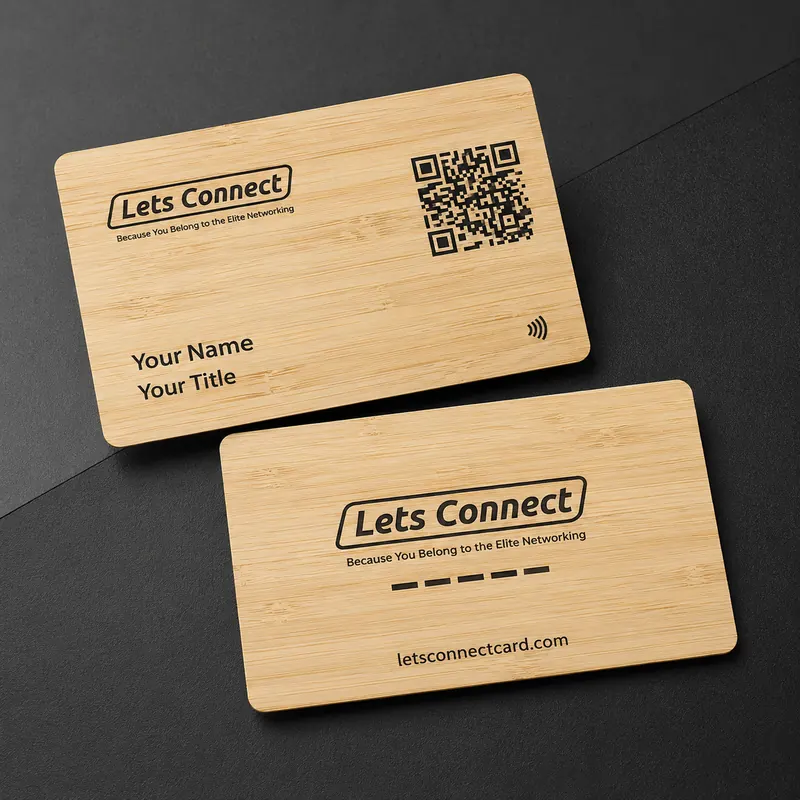
Every card in this store is 85.6 × 54 mm, the ID-1 size rounded to the nearest tenth of a millimetre. That size was chosen because the cards are made of PVC, bamboo or metal and carry an NTAG215 NFC chip, like a contactless bank card.
Why the credit-card size fits
- Wallets and purses have slots made for bank cards. A card of the same size slides in and stays put.
- Card holders and phone cases with card slots are made to the same size.
- It is familiar. People know how to hold and keep a card this shape.
- It travels. The same size is used for bank cards in most countries, so it fits wallets abroad too.
A US card is slightly longer and narrower than a bank card. A European card is slightly shorter. Japanese and Australian cards are a little longer. In practice, all of them fit most wallets, but a credit-card size card fits a bank-card slot exactly.
Bleed and safe zone basics
If you design your own artwork, two terms matter: bleed and safe zone.
Bleed
Bleed is extra artwork beyond the edge of the card. Printing and cutting are never perfectly aligned, so a background colour or image that should reach the edge is extended slightly past it. When the card is trimmed, there is no thin white line along the edge. Printers commonly ask for a few millimetres of bleed on each side. Always check what your printer asks for.Safe zone
The safe zone is the area inside the edge where important content belongs: your name, role, logo and QR code. Keeping these a few millimetres in from the edge means nothing is trimmed off or looks cramped.
Resolution
Artwork for print should be sharp at actual size. A logo copied from a website is often too small and prints blurry. Use the original file from your designer, ideally a vector file or a high-resolution image.
Rounded corners
Many plastic and metal cards have rounded corners, like a bank card. Keep important content away from the corners.
The QR code
A QR code needs clear space around it, sometimes called a quiet zone, so phones can read it. Don't place text or artwork right up against it.
Checking artwork at actual size
Before you send artwork, view it at actual size. Print it on paper at 100% and cut it out, or hold a bank card against your screen at the right zoom. Check that your name reads easily, your logo is not too small, and nothing sits too close to the edge. This takes two minutes and catches most layout problems.
Designing for a card from this store
If you use the Fully Custom Design add-on, £30 in the UK, you upload artwork for the front and back. Make it for a card of 85.6 × 54 mm, keep your name, role and logo well inside the edges, and leave room for the QR code. If you are unsure about bleed or margins, contact us before you design. We reply within 48 hours.
Then check the digital proof we send after checkout. Production starts only after you approve it. What you approve is what is printed.
If you would rather not design artwork, the Add Logo add-on, £20 in the UK, prints your logo on the standard layout. Our guide to visiting card finishes explains how a PVC, bamboo or metal card differs from a printed paper card.
Size and etiquette abroad
A card that fits a local wallet is easier to keep, and the visiting card etiquette rules apply everywhere. In Japan and other East Asian markets, people often keep cards in a card case, and a credit-card size card fits most cases. For customs in twelve countries, read our guide to visiting card etiquette by country.
Frequently asked questions
What is the standard visiting card size in the US?
3.5 × 2 inches, which is 88.9 × 50.8 mm.
What is the standard visiting card size in the UK?
85 × 55 mm is the common size for paper cards in the UK and most of Europe.
How big are the cards from this store?
85.6 × 54 mm, the size of a bank card, defined as ID-1 in ISO/IEC 7810.
Will a credit-card size card fit in a wallet?
Yes. It fits the card slots in most wallets, purses, card holders and phone cases.
What is bleed on a visiting card?
Extra artwork beyond the edge, so colour reaches the edge after trimming without a white line.
Where should I put my name and logo?
Inside the safe zone, a few millimetres in from the edge, away from rounded corners and clear of the QR code.
Is the credit-card size the same everywhere?
Yes. ID-1 in ISO/IEC 7810 is an international standard, used for bank cards in most countries.
Keep reading
Browse all guides, read visiting card etiquette by country and visiting card finishes explained, or choose your card.